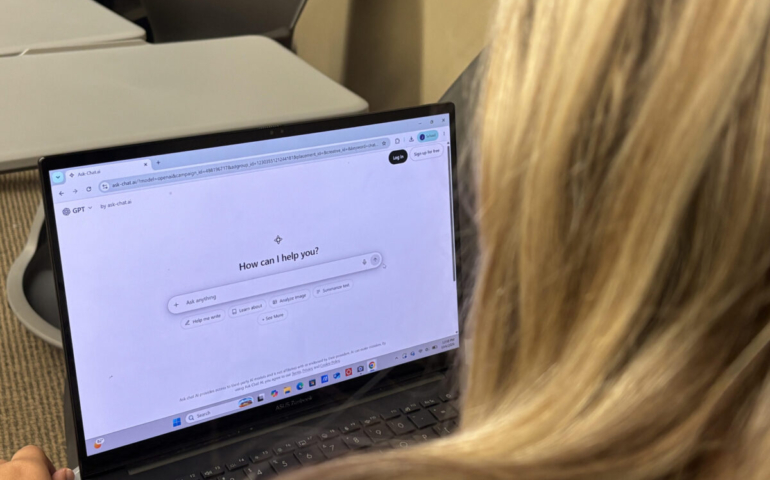
Artificial intelligence has quickly become part of everyday life, including college classrooms. Students can use tools such as Gemini and ChatGPT to research, brainstorm, answer questions, and summarize information. But as AI becomes more embedded in higher education, a fundamental question remains: When does AI serve as a tool for learning, and when does it become a shortcut around it?
At SNU, faculty members have varying perspectives on how AI should be used. Dr. Scott Marsee, vice president of learning and innovation; Dr. Mark Winslow, senior vice president and chief academic officer; and Robby Patton, instructor of Christian faith and life, each offered insight on how faculty and students can navigate the rapidly evolving technology.
Marsee considers himself a supporter of AI while emphasizing that students and faculty must use it responsibly.
“I am for AI, but in the right and responsible use of AI,” Marsee explained.
Marsee uses AI in his own work to brainstorm ideas, process information, and refine his writing. He noted that the technology has not replaced his independent thought, but has become a collaborative partner.
“It hasn’t replaced the thinking. It hasn’t done the writing for me,” Marsee stated. “But it’s been a help. It’s been a partner.”
For Marsee, transparency and integrity are key. Rather than asking AI to write an entire paper or email, he does the work himself and uses the technology to review wording or explore different angels.
“If you use AI, especially if it’s optional, just be transparent about it,” Marsee commented. “Be open and transparent with your professors.”
Marsee also acknowledged that SNU faculty members approach new technology at different speeds. While some eagerly embrace innovation, others take a more cautious, wait-and-see approach. He said the university’s goal is not to make every faculty member approach AI in exactly the same way, but to foster ongoing conversations about innovation and learning.
Winslow also utilizes AI in his work, including brainstorming, searching for information, and analyzing data. However, he does not want his students to use AI simply to get an assignment done.
“The challenge, though, of teaching and learning, is that you don’t want students to use AI to just get through,” Winslow said. “It needs to be purposeful.”
Winslow believes AI should be treated as a supplemental resource rather than a direct solution. Students still need to think critically and demonstrate that they understand the material themselves. The expansion of AI may also require professors to reconsider how they evaluate student learning.
Winslow said assessment methods may need to change to determine whether students have actually learned what they are expected to learn.
While Marsee and Winslow see opportunities for using AI in education, Patton takes a more cautious approach, particularly in his Christian Faith and Life classes.
Patton recognizes that AI can offer benefits, but he worries that students may begin relying on technology instead of working through intellectual challenges themselves.
“Is it something that causes us not to actually think through what we are being challenged with?” Patton asked. “I’m concerned about that, because that’s what causes our brains to develop and grow.”
Patton discourages students from using AI to complete assignments or replace their engagement with course material. He believes students can miss an important part of learning when they use AI to avoid struggling with difficult material.
“You’re shortchanging yourself because you’re here to learn,” Patton remarked.
This concern is especially relevant in faith-based courses, where students are asked to engage with their own beliefs and experiences.
“There’s nothing that an automated system is going to know about your personal faith journey,” Patton said.
Patton encourages students to be present in the classroom rather than relying on technology to summarize material later. He wants students to wrestle with difficult questions, participate in discussions, and spend time processing what they are learning.
“AI is not the Holy Spirit,” Patton stated. “AI cannot mediate the Holy Spirit. AI cannot speak for the Holy Spirit.”
For Patton, learning also requires time. He believes students can become accustomed to instant answers and turn to AI when they procrastinate on assignments. Instead, he encourages students to give themselves enough time to research, read, write, and think.
“It can be helpful, but within limits,” Patton noted.
These differing viewpoints show that the conversation about AI at SNU is not simply divided between advocates and opponents. Instead, faculty members are examining how AI can be used without replacing the effort, critical thinking, and personal experiences that make education meaningful.
As AI continues to grow, SNU students will likely encounter it throughout college and eventually in their workplaces. The challenge may not be deciding whether AI belongs in education, but learning when it is appropriate to use it and what role it should play in the learning process.
Photo by: MaK Wilkerson